
Plant-Based Challenges
The faux meat sector has hit significant headwinds.

Photo by Rachel Claire
It’s tempting for the traditional meat industry to feel a tad smug about the free-fall of Beyond Meat’s stock as they struggle to meet demand expectations for their plant-based products. The last 12 months certainly haven’t been pretty for the major players in the plant-based space.
What we are learning is that the customer experience with the product still trumps whatever philosophic reasons we may have for purchasing protein that hasn’t passed through an animal. And so the only repeat buyers are the ones determined not to eat real meat. Probably the same people still eating kale after everyone else realized how unappetizing it was.
The billion-dollar question is can the plant-based companies change the customer experience enough to make their products more naturally appealing to a broader consumer base? The follow-on question is can the cell-based meat alternatives do any better in the taste department? In other words, has science been able to replicate the natural meat-eating experience?
The short answer to all these questions is no. It is incredibly hard to copy all of the smell, taste, and texture qualities of cooked meat from an animal in a plant or cell-based alternative. And even if we can get there with science (which many are determined to do), we have some fundamental business problems to deal with.
Here are the main ones:
1. It’s still too cheap to produce real meat. The livestock industry has had many years to fine tune the system. In fact, there is probably more science behind animal nutrition than human nutrition. Today, we are creating animal-based protein far more efficiently than we did just 20 years ago. And it’s getting better every year as we continue genetic improvement and fine-tune animal nutrition strategies. Increased yields of corn and soybean crops will also help because animals process these staple crops into protein more efficiently than artificial processes. Even the specter of increased animal diseases is being addressed with new early detection technologies involving computer vision and AI.
2. Humans don’t like change. This is behavioral science 101 and big brands have leveraged this to the hilt. Once we get into a habit - even a bad one - it is very hard for us to change. That’s why the junk food business is as big as it is. Our carnivorous habits are even more entrenched. We are, whether you like it or not, a meat-eating culture. Plant-based alternatives will need to spend a boatload more Silicon Valley VC dollars on clever marketing to change that. It’s hard to believe that the VCs will keep throwing money into that big hole. They do have a duty to earn a return for their investors.
3. The political winds are blowing in the wrong direction. The plant-based players were betting that most people’s buying behavior would be influenced by a growing environmental or sustainability consciousness. That is turning out to be a bust. Most Americans lean right-of-center when it comes to food politics. That means that most will rush to support traditional farming practices over a left-of-center agenda that whiffs of environmental or sustainability righteousness. There definitely is a generational split on this. All the recent buying behavior studies have shown that people under 30 are going to be far more sympathetic to the plant-based narrative than older buyers. The big question is whether this sympathy will stick as they age or if they will become traditionalists and pine after the comfort food of their youth. Smell and taste have strong associations with our memories. Don’t underestimate the power of nostalgia.
4. We are still carnivores. Physiologically, we crave meat and our bodies need elements in natural meat like carnitine to support proper metabolism. Carnitine feeds our mitochondria, helping our organs function properly and helping power important biochemical reactions in our cells. All carnivores need it, including cats and dogs. A vegan pet owner will need to supplement carnitine if they choose to withhold meat from their dog or cat. Bottom line: meat eaten in moderation is a very important part of a healthy diet.
Briefly
A report from CoBank says the current high-pathogenic AI afflicting millions of chickens in the US is not the only cause for a big spike in egg prices. The report cites extreme shifts in consumer behavior during 2020.
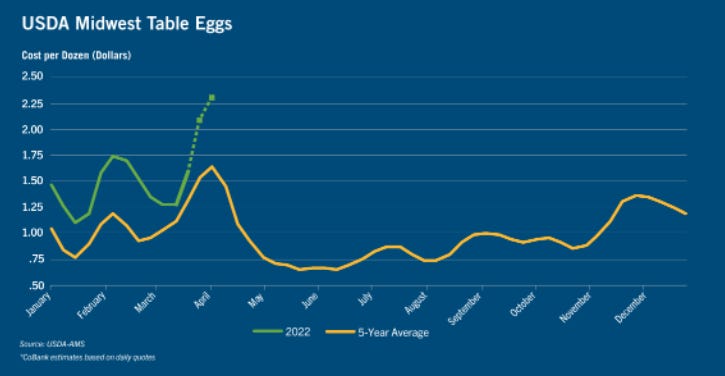
Egg producers were not ready to shift lost food service volumes into retail channels when consumer demand spiked during the pandemic. “The lack of packaging equipment and supplies led to empty store shelves, sky-high retail prices, and ultimately, lower egg consumption," according to Brian Earnest, CoBank’s lead animal protein economist. As of the beginning of April, egg prices had spiked over 50% since the first HPAI case was announced on February 8.
The University of Nebraska-Lincoln has received a A $203,752 grant from the U.S. Department of Agriculture to study the cattle packing industry. The study, led by UNL agricultural economist Azzeddine Azzam, will examine industry conduct during the COVID-19 plant shutdowns and will analyze the economic ramifications from expanding local meat processing through the creation of small packing operations. Azzam plans to look at a wide array of ag-sector factors to reach conclusions for economic understanding and guidance for public policy.
Animal health startup MyAnIML is developing a cattle early disease detection platform which uses facial recognition technology. The company says they can read subtle changes in bovine muzzles to identify diseases as far as two to three days in advance of any clinical symptoms. Their initial target is highly infectious diseases such as pinkeye which can cost over $13,000 in treatment and over $39,000 loss in revenue to a 500 head herd, myAnIML claims.
Deals
Better Origin, a British developer of insect mini-farms, raised $16m in Series A funding. Balderton Capital led, and was joined by insiders Fly Ventures and Metavallon VC.
Israeli-based Beewise Technologies has closed on an $80 million Series C round led by New York-based venture capital and private equity house Insight Partners and bringing total funding to more than $120 million. Beewise has developed a proprietary robotic beehive designed to increase pollination capacity by detecting and responding to threats to a honeybee colony such as pesticides and the presence of pests.
California-based Umaro Foods raised $3 million in seed funding for a technology which turns seaweed into a protein source and functional ingredient for meat analogs. AgFunder led the investment with participation from Alexandria Venture Investments, Impact Science Ventures, Ponderosa Ventures, Clear Current Capital, Ahimsa Foundation, and Sustainable Food Ventures.
Subscribe below to Protein Insights to get the next issue in your inbox and stay on top of news and technology trends in the protein industry. You might also be interested in our other ag-focused newsletter Modern Crop and our Demand Insights newsletter on trends impact consumer food demand.
If you have a new protein-based technology to talk about or other news about the protein industry to share, contact us at proteininsights@dekenmedia.com.